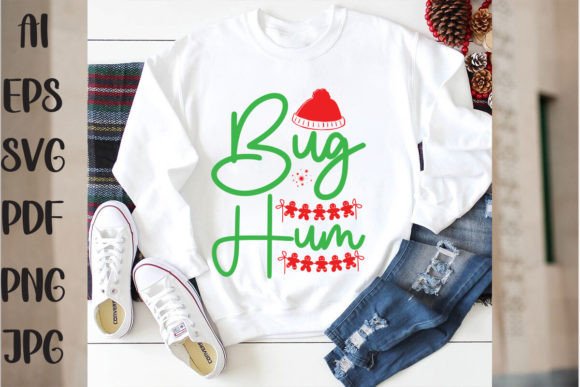
Hum Bug: A Designer’s Take on Holiday Stitching
As an embroidery designer who has spent countless hours digitizing and stitching out holiday motifs, I approach every new machine embroidery design with a mix of excitement and skepticism. The market is flooded with seasonal graphics, but few stand up to the rigors of actual thread work. When I first encountered Hum Bug, part of the Trendy Pod Best T-Shirt Design Bundle, my initial reaction was curiosity. The name suggests a playful twist on traditional Christmas cheer, likely leaning into the grumpy-cat or sarcastic humor trend that dominates modern T-Shirt Designs. But does this digital asset translate well from screen to fabric?
My review focuses on practical application. I am not just looking at the PNG or EPS files provided; I am evaluating how this Graphics package performs when translated into a tangible embroidery project. Whether you are an Etsy seller preparing for the holiday rush or a hobbyist making gifts, understanding the structural integrity of your design is crucial before you hit the start button.
First Impressions and Visual Personality
The Hum Bug design carries a distinct mood. It is not the saccharine, overly sweet aesthetic of traditional holiday decor. Instead, it offers a witty, slightly rebellious vibe that appeals to a younger demographic or those who prefer understated humor. In terms of layout, the design appears balanced, which is essential for maintaining symmetry during stitching. The inclusion of three color variations, along with white and black options in the bundle, provides immediate versatility. This allows us to visualize how the design interacts with different thread colors and fabric texture backgrounds without needing to manually recolor the digitized file immediately.
For a custom apparel piece, this visual personality is a strong selling point. It moves beyond generic snowflakes and reindeer, offering a conversation starter. However, as designers, we must look past the cute factor and assess the line work. Since the source files are SVGs and high-resolution PNGs intended for print, converting this into an embroidery file requires careful attention to detail. The curves must be smooth enough to prevent thread breaks, and the spacing between elements must accommodate the natural pull of the thread.
Real-World Application: The Sweatshirt Test
To truly evaluate Hum Bug, I imagined a specific real-life scenario: creating a premium sweatshirt embroidery item for a boutique client. The goal was a cozy, oversized crewneck that feels luxurious yet fun. I placed the design on the left chest area, a classic spot for subtle branding or personalization. On a heavy cotton blend fleece, the design needs to hold its shape without sinking into the nap of the fabric.
In this context, the design’s simplicity works in its favor. Complex, tiny details often get lost in thick fabrics, but Hum Bug relies on bold shapes and clear lines. This makes it an excellent candidate for a fill stitch background with clean satin stitch borders. If you are using the black or white versions from the bundle, the contrast against heather grey or navy fleece is striking. It creates a professional finish that enhances the perceived value of the handmade product. Customers are more likely to trust a brand that delivers crisp, clean stitching rather than a muddy, over-digitized mess.
Versatility Across Product Lines
Beyond sweatshirts, this design shows promise in several other categories. For a tote bag design, the durability of the stitch pattern is key. Totes undergo significant stress and washing. A design like Hum Bug, if digitized with appropriate stitch density, can withstand frequent use. It also translates well to embroidered patch creation. Patches allow for higher density stitching since they are made on stiff stabilizer before being applied. This means you can push the detail level further, creating a textured, tactile accessory that can be ironed onto jackets or hats.
For baby embroidery projects, caution is advised. While the theme might be adapted for a "Grumpy Baby" onesie, the scale must be reduced significantly. Small hoop sizes require meticulous checking of tiny elements. If the design includes fine lines or small text, these may merge together when stitched at a smaller scale. Always test on scrap fabric first to ensure clarity.
Technical Considerations for Embroiderers
Since Hum Bug is provided as a graphic bundle (PNG and EPS), it is not a ready-to-stitch digital embroidery file like DST or PES. This is a critical distinction for craft business owners. You will need to digitize this design yourself or hire a digitizer. When doing so, consider the following:
- Stabilizer Selection: For stretchy fabrics like t-shirts, use a cut-away stabilizer to prevent distortion. For woven fabrics like aprons or pillow covers, a tear-away may suffice depending on the stitch density.
- Thread Contrast: The bundle includes black and white versions. Use these to test your digitizing. If the design looks good in high-contrast black and white, it will likely hold up well in color. Poor contrast often reveals weak structural design.
- Hoop Size: Confirm the maximum dimensions. The PNGs are 15in and 18in, which is large for standard home machines. You may need to resize the design significantly for caps or small gifts. Ensure that resizing does not distort the aspect ratio.
- Fabric Texture: Textured fabrics like terry cloth or corduroy can obscure fine details. Hum Bug should be tested on these surfaces to determine if underlay stitches are needed to lift the design above the fabric pile.
Commercial Viability and Brand Consistency
For small shop product lines, consistency is vital. Hum Bug fits well within a broader collection of witty, modern holiday items. It allows for cohesive branding across different products, from kitchen towel accents to holiday embroidery on throw pillows. When customers see a consistent aesthetic, it builds trust and encourages repeat purchases.
However, always verify the licensing terms of the Trendy Pod bundle. While it is marketed for commercial embroidery and print, ensure that the license covers the sale of physical embroidered goods. Some licenses restrict the number of units sold or require attribution. As a professional, protecting your business from legal issues is as important as the quality of your stitching.
Final Verdict
Hum Bug is a strong contender for designers looking to add a touch of modern humor to their holiday offerings. Its strength lies in its bold, clear shapes that translate well to various fabrics and products. While it requires proper digitization from its graphic source files, the potential for high-quality finished product output is significant. By paying attention to stitch density, stabilizer choice, and fabric compatibility, you can turn this graphic asset into a best-selling item for your Etsy seller store or local craft fair. Remember, the best designs are those that not only look good on screen but survive the needle, the thread, and the wash cycle with their charm intact.